
Building on Eternity: The Challenge of Brach Rome
There is a question that the high-end real estate market is asking with increasing attention: where does value reside today?
Rome has always answered with the strength of its heritage — noble palaces transformed into prestigious addresses, trophy assets brought back to the present through ambitious restorations. The prevailing trend in its luxury hospitality market has been the regeneration of existing buildings: a choice that is understandable, often virtuous, and almost always inevitable.
It is within this context — where the established approach is to restore historic palaces, to work through subtraction and conservation — that Brach Rome takes shape with an unconventional choice. The new five-star hotel by the French group Evok Collection is expected to open in the first quarter of 2027 on Via Luisa di Savoia, just a hundred meters from Piazza del Popolo.

A New Building in an Ancient Heart
At first glance, the news is that of a hotel opening. In reality, it is something rarer and more significant: a completely new building in the very center of Rome.
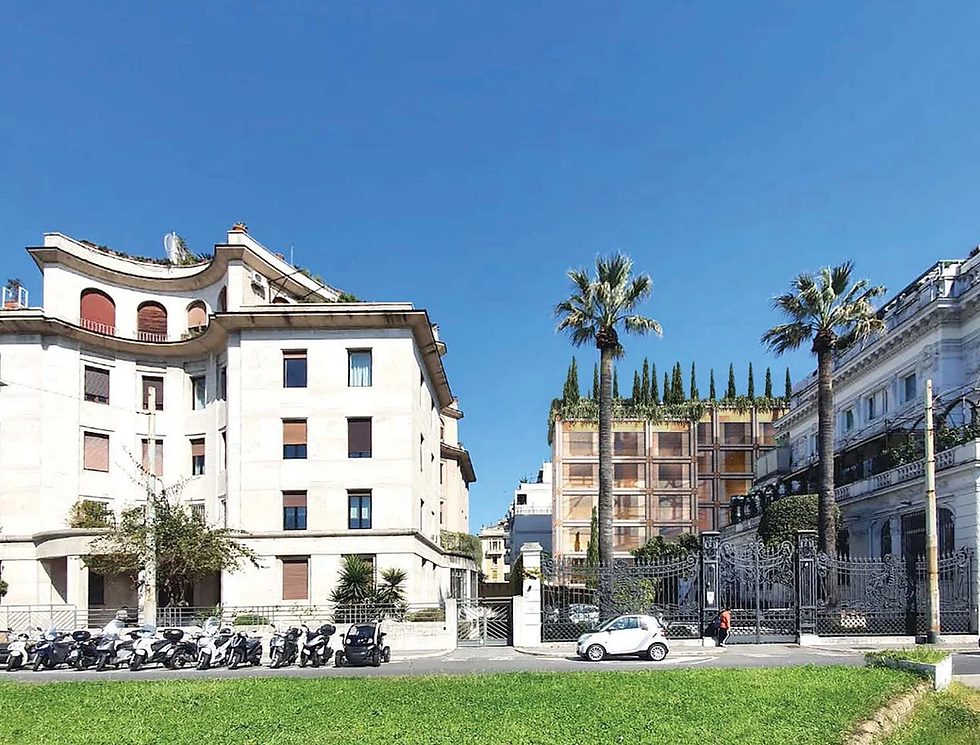
Where, until a few years ago, a school built in the 1950s stood, a new 5,000-square-meter structure is now being developed from the ground up, designed by Philippe Starck.
Not a renovation, not a restoration: a new piece of architecture — a generative act in a city that, for too long, has thought primarily in terms of subtraction.
Starck, working alongside the Roman firm Surf Engineering led by Raffaele Giannitelli, has conceived a building in calm dialogue with its surroundings: iron, glass, and cypress trees on the rooftop. A contemporary presence that does not claim rupture, but integrates coherently among the nearby Liberty-style buildings and the rationalist palazzine of the 1930s.
It is a particularly meaningful demonstration, in a city like Rome, that classical and contemporary architecture can not only coexist, but engage in dialogue.
The Brach Philosophy: Luxury as Urban Energy
Evok Collection is not a conventional operator. The group has built its positioning on an idea of luxury that rejects isolation. Its hotels do not withdraw from the world — they move through it. They live at the rhythm of the neighborhood, designed as much for those arriving from afar as for those who already inhabit the city.
Brach Paris, opened in 2018 in the 16th arrondissement, was the manifesto of this vision. Brach Madrid, launched in 2025, followed the same trajectory. Rome, the brand’s third international destination, is not a replication but an evolution: the most layered city in Europe, the most faithful to itself, and the one most capable of amplifying the meaning of whatever touches it.
The project includes around sixty rooms and suites, many with private terraces, organized around a social core: the Brach restaurant, a patio, and an Italian bar conceived as places of encounter rather than service.
A panoramic rooftop, a 25-meter pool, a wellness club. But above all: an atmosphere. That familiar sensation, known to those who have experienced Brach properties around the world, of being in a place defined by character before comfort.
What a Hotel Does to a Street, a Neighborhood, a Market
For those who read real estate with a long-term perspective, the story of Brach Rome conveys something precise and important.
The area around Piazza del Popolo and Flaminio has long been one of the most closely watched by high-end residential investors.
The arrival of a branded address, backed by the cultural weight of Starck and the operational credibility of Evok, is far from neutral for its surroundings. Luxury hospitality trophy assets have a documented impact on nearby residential values: they validate a neighborhood, signal a direction, and attract an international, high-profile audience that also looks toward purchasing opportunities.
This is not theoretical speculation — it is the history of every major opening of this kind across Europe’s leading capitals. And Rome, which in recent years has regained lost ground with arrivals such as Six Senses, Orient Express, Four Seasons, Bulgari, and Rosewood, is defining new benchmarks for international luxury.
Brach Rome enters this narrative with something different: an entirely new building, an architectural statement, a bet on the future that does not rely on the yield of history, but completes it.
Reading the Present to Anticipate Value
At Krhome Real Estate, reading the Roman market begins with a clear premise: contemporary luxury is no longer just a matter of surface. It is measured in context — who the neighbors are, what story is being written around a place, which visions are converging on a specific part of the city.
Brach Rome, with its opening scheduled for 2027 and sales starting in July 2026, is one of those signals worth reading carefully. Not as industry news, but as an indicator of direction.
Because often, in mature markets like Rome, value does not announce itself: it emerges in advance — in the form of a construction site, a rendering, a cypress tree on the roof of a building still under development.


Comments