
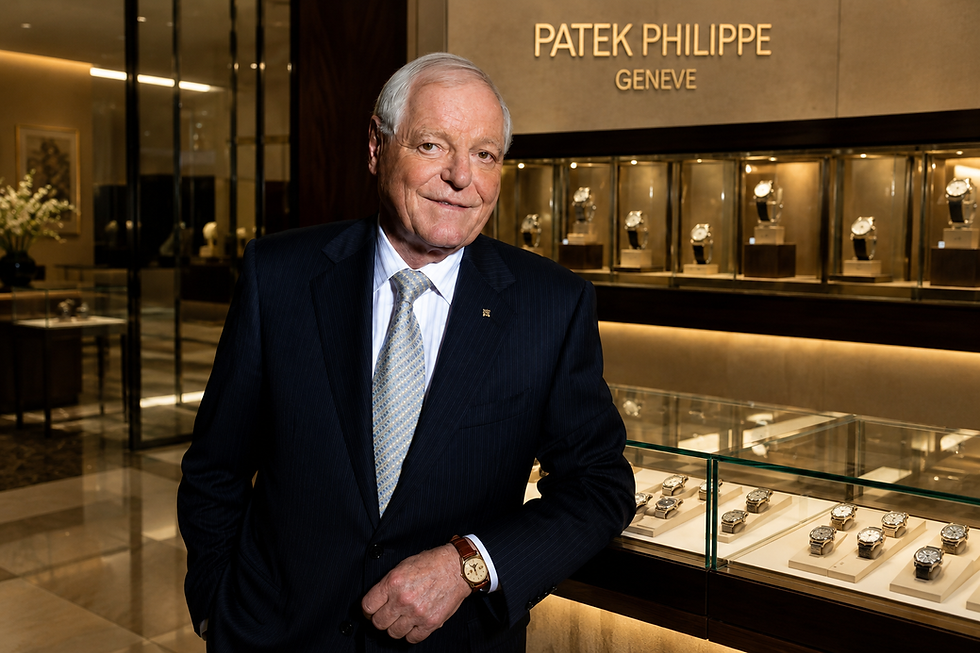
Philippe Stern: the future comes from afar
When the market races toward the future, the most counterintuitive choice can be to look back.
Philippe Stern did exactly that during one of the most difficult periods in Swiss watchmaking.
When quartz seemed destined to make mechanical watchmaking obsolete, Stern chose to invest precisely in what the market considered less efficient: craftsmanship, complexity, research, and time.
A decision that would help transform Patek Philippe into one of the absolute benchmarks of contemporary haute horlogerie.
The Strength of What Seemed Outdated
In 1977, the calibre 240 was born: an ultra-thin automatic movement developed at the height of the quartz crisis.
The idea was not to compete with new technology on the grounds of precision or efficiency.
It was to enhance what made mechanical watchmaking different: complexity, craftsmanship, elegance, longevity, and intrinsic value.
A choice that says something larger than the history of Patek Philippe.
Value does not always come from what represents the future. Sometimes it comes from what the future seemed to have left behind.
The Return of the Past in Luxury
It is a dynamic we can see today in design and architecture as well.
Contemporary interiors are rediscovering craftsmanship, tactile materials, ornamental details, traditional decorative techniques, and references to earlier eras.
In its Interior Design Forecast 2026, Architectural Digest highlights growing attention to texture, craftsmanship, passementerie, decorative elements, and interiors that feel more personal and layered.
The return of Art Deco follows the same logic: according to Architectural Digest, in 2026 the Deco language is being reinterpreted through rich materials, sculptural forms, and contemporary details rather than faithfully reproduced.
It is not nostalgia. It is selection.
The past is broken down, reinterpreted, and introduced into contemporary spaces because some of its qualities — materiality, craftsmanship, character, uniqueness — once again respond to the needs of the present.
A Home with Something to Say
In luxury real estate, this phenomenon takes on a particularly interesting dimension.
After years in which neutrality, minimalism, and standardization played a central role in shaping taste, especially in the contemporary segment, interest is growing again in what gives a space identity: a historic building, original craftsmanship, an authentic material, an architectural detail that is difficult to replicate.
The point, however, is not to preserve the past unchanged.
It is to understand what deserves to be preserved and what can be reinterpreted.
This is where historical value meets contemporary comfort: technology, efficiency, more functional layouts, and services can coexist with elements capable of giving a property an unmistakable personality.
Scarcity That Cannot Be Replicated
In this sense, the character of a property can become a form of scarcity: something that cannot simply be added later, because it belongs to the history, materials, and very identity of the building itself.
And it is precisely this uniqueness that is becoming increasingly valuable in a segment where quality is defined not only by what a property offers, but also by what no other property can offer in quite the same way.
In luxury real estate, this means being able to recognize the value of what cannot be replicated, even before the market makes that value obvious.
It is what Philippe Stern understood long before it became clear: when a market changes, not everything from the past loses its value.
Some things are simply waiting to be desired again.


Comments